RICO Matrix Whitepaper: Token Utility, Tokenomics, Staking and Web3 Publishing
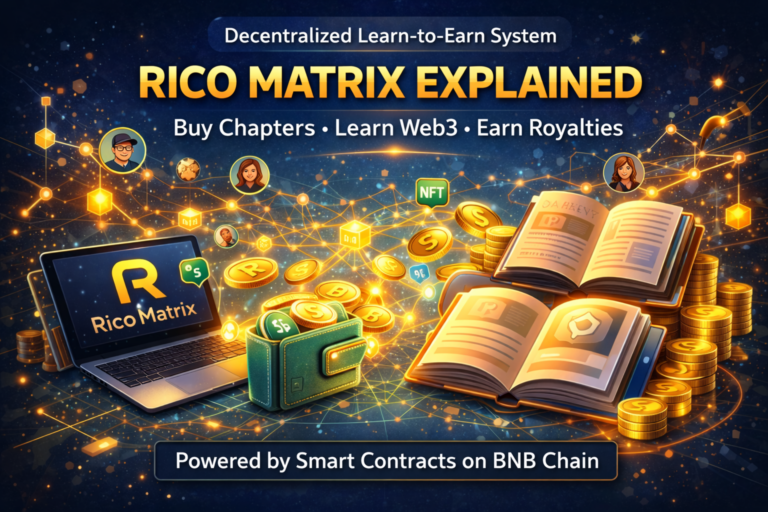
In the crypto world, many projects launch a token first and try to find a purpose later. RICO Matrix takes a different path. It is built around a bigger idea: create a digital ecosystem where people can publish knowledge, buy access to content, earn rewards for participation, stake tokens for yield, and help grow a community-driven platform all in one place. The native token that powers that ecosystem is called RICO, and it runs on BNB Smart Chain. (rico-matrix.gitbook.io)
The easiest way to understand RICO Matrix is to stop thinking of it as “just another coin.” Think of it as a digital town. In that town, writers can open shops, readers can buy useful knowledge, active community members can help decide what deserves attention, and long-term supporters can lock in their tokens to earn rewards. Instead of the platform existing only for trading, it is designed so that the token sits inside the daily life of the ecosystem. (rico-matrix.gitbook.io)
Imagine an older schoolteacher named Mama Grace. She writes a simple book teaching young parents how to help children read at home. On a normal internet platform, a company in the middle may control her audience, her payments, and even her access to buyers. In the RICO Matrix model, Mama Grace can publish her knowledge into a decentralized library, readers can buy access, and the economic activity can benefit not only her, but also the wider ecosystem. That is the heart of the project. (rico-matrix.gitbook.io)
The Problem RICO Matrix Is Trying to Solve
Most online platforms today work in a way that many creators already know too well: the platform controls traffic, controls discovery, controls monetization, and often takes a heavy share of the value. In other words, the person creating the value is not always the person keeping the value. RICO Matrix is built around the idea that creators should be able to monetize knowledge more directly, users should be able to own access in a wallet-linked way, participation should be rewarded, and token utility should grow as platform usage grows. (rico-matrix.gitbook.io)
There is also a second problem in crypto itself. Many tokens have hype, but no real product. Others have staking, but no durable reason for people to keep using the token. Some have communities, but no real monetization engine behind them. RICO Matrix tries to combine product, publishing, monetization, staking, rewards, and scarcity into one connected system. (rico-matrix.gitbook.io)
Picture a village market. If people only gather there to shout prices but nobody is actually buying or selling, the market has noise but no life. That is how many token projects feel. RICO Matrix is trying to build a market where real activity happens: books get published, people buy access, rewards circulate, some tokens get burned, and long-term holders get incentives to stay. (rico-matrix.gitbook.io)
Why the Market Opportunity Matters
RICO Matrix sits at the meeting point of two very large markets: digital education and the creator economy. The project materials cite e-learning market estimates ranging from $299.67 billion in 2024 toward $842.64 billion by 2030, with an alternative forecast projecting $356.66 billion in 2025 to $1.31 trillion by 2032. The same materials also cite creator economy estimates of $202.56 billion in 2025 growing toward $848.13 billion by 2032, with Goldman Sachs estimating the creator economy could reach $480 billion by 2027. (rico-matrix.gitbook.io)
Why does that matter? Because RICO Matrix is not trying to invent a use case out of thin air. People already spend money on learning, digital books, courses, skill development, creator-led products, and community-based educational experiences. The project is trying to place itself inside spending habits that already exist. (rico-matrix.gitbook.io)
Think of it this way: if you build a new shop in the middle of an empty desert, you first need to create traffic. But if you build a smart shop at the junction of two busy roads, your job becomes easier. RICO Matrix is trying to stand at the intersection of education and creator monetization, two roads that are already full of traffic. (rico-matrix.gitbook.io)
What RICO Matrix Actually Is
RICO Matrix is a multi-layer ecosystem. It is not just a publishing app, and it is not just a staking platform. It combines several layers that work together:
a publishing layer, where authors publish books and digital knowledge products
an access ownership layer, where readers receive wallet-linked, soulbound access to purchased content
a staking layer, where holders can stake RICO for rewards, bonuses, redistribution benefits, and compounding opportunities
a community reward layer, where participation can generate ecosystem-linked rewards
a learn-to-earn layer, where educational engagement ties into incentives
a burn layer, where several ecosystem actions remove RICO from circulation (rico-matrix.gitbook.io)
That structure matters because each layer is meant to strengthen the others. More publishing can mean more token utility. More purchases can mean more revenue flow and more burn activity. More staking can mean more supply locked up. More participation can make the community stronger. The design tries to make growth in one area reinforce the whole system. (rico-matrix.gitbook.io)
Imagine a farming family. One person plants, another waters, another sells in the market, and another stores grain for future use. Each person does a different job, but together they create a full cycle. That is the idea behind the RICO Matrix structure: each layer has a different role, but all of them feed one economic loop. (rico-matrix.gitbook.io)
How the Ecosystem Works in Real Life
The project is built around four main participant groups: authors, readers, community members, and holders or stakers. Each group plays a different role in keeping the ecosystem alive. (rico-matrix.gitbook.io)
1. Authors
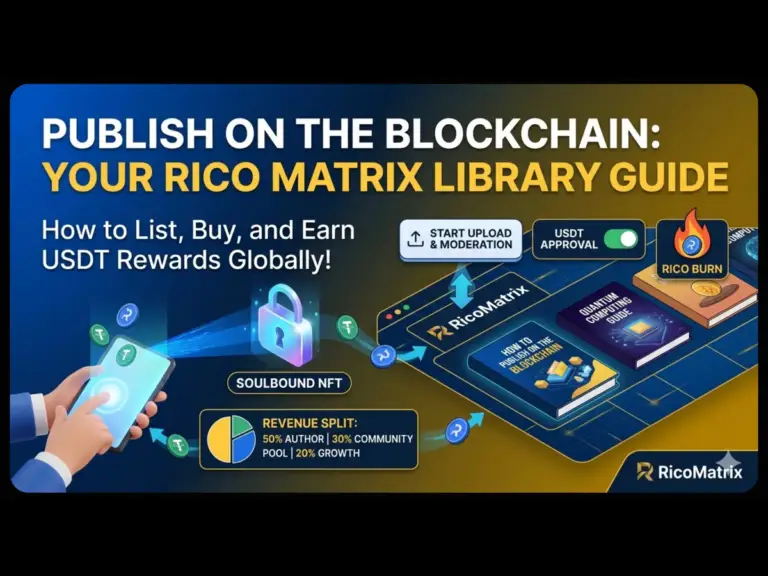
Authors can prepare content, pay a publishing fee, list content on-chain, and receive revenue when users buy access. This means creators are not just posting for attention. They are entering an economic system where their content can become a direct source of income. (rico-matrix.gitbook.io)
Think again of Mama Grace. She writes her reading guide, uploads it, pays the listing cost, and makes it available in the platform library. Instead of hoping a social media algorithm notices her, she now has a direct route into a marketplace built for knowledge products. (rico-matrix.gitbook.io)
2. Readers
Readers browse content, complete a transaction, receive wallet-linked access, and then participate further through usage and rewards. In plain English, readers are not just customers passing through. They can become part of a broader ecosystem. (rico-matrix.gitbook.io)
Imagine Mr. Okoro, a retired teacher who wants to learn small-scale fish farming after leaving formal work. He buys a digital guide on the platform. He is not only getting information; he is also stepping into a system that recognizes reading, participation, and long-term activity as meaningful behaviors. (rico-matrix.gitbook.io)
3. Community Members
Community members can help with content discovery and curation. That can include voting on books, voting on authors, shaping visibility, and influencing reputation. These actions are not treated as empty likes; they can become economically meaningful parts of the ecosystem. (rico-matrix.gitbook.io)
Think about a trusted elder in a town who tells everyone which tailor is honest and which shop has the best rice. That recommendation changes where people go. In RICO Matrix, community curation plays a similar role. It helps the best content rise and gives participation real weight. (rico-matrix.gitbook.io)
4. Holders and Stakers
The fourth group consists of people who hold or stake RICO. These users support the longer-term health of the system by locking tokens for a period in exchange for yield, bonuses, redistribution rewards, compounding opportunities, and possible airdrop eligibility. (rico-matrix.gitbook.io)
This is like storing seed yam for the next planting season instead of eating everything today. The family that stores wisely may suffer less later and may gain more when planting time comes. Staking is the ecosystem’s way of rewarding patience. (rico-matrix.gitbook.io)
What the RICO Token Actually Does
The RICO token is the native utility token of the ecosystem. It is not described as a token that sits outside the platform. It sits inside the platform and is used by the system in several ways. (rico-matrix.gitbook.io)
First, it powers the publishing engine. Authors use 100 RICO per listing to publish content. That means whenever creators list books or digital knowledge products, the token becomes part of real platform activity. (rico-matrix.gitbook.io)
Second, it acts as part of the transaction layer. The published docs describe 5 RICO per purchase as part of purchase activity, linking reader demand directly to token usage. The more people buy content, the more the token gets involved in actual platform behavior. (rico-matrix.gitbook.io)
Third, it supports decentralized curation. Community members can use RICO in systems such as voting on books and authors. That gives the token a role in deciding which content rises, not just in paying fees. (rico-matrix.gitbook.io)
Fourth, it powers staking and yield utility. Holders can stake RICO to access APY-based rewards, bonuses, redistribution rewards, compounding strategies, and airdrop eligibility. (rico-matrix.gitbook.io)
Fifth, it supports an access economy. Purchased content can be represented through wallet-linked, soulbound access models. Put simply, access is tied to your wallet in a Web3-native way rather than working only like a normal password-based subscription. (rico-matrix.gitbook.io)
Think of RICO like the token used inside a well-run community fair. One part helps people rent a stall, another helps customers buy goods, another helps organizers track loyal participants, and another helps the fair reward people who support it over time. That is why RICO is more than a tradable asset. It is the operating fuel of the system. (rico-matrix.gitbook.io)
RICO Tokenomics Explained in Simple English
The token supply model is one of the most important parts of the project. The published tokenomics show a total supply of 100,000,000 RICO on BNB Smart Chain, with 25% burned at launch or allocated to burn. (rico-matrix.gitbook.io)
The allocation breakdown is listed as:
25% exchange liquidity
25% burned
10% strategic and treasury
10% ecosystem and staking
10% presale
10% global marketing
5% team
5% community airdrop (rico-matrix.gitbook.io)
The pricing section also outlines a presale price of $0.033, a listing price of $0.035, and a listing date of 25 September 2026, with the pair listed as RICO/BNB. Since today is April 1, 2026, that listing date is still a future milestone in the project documentation, not a past event. (rico-matrix.gitbook.io)
Now let’s make that simple. Imagine a family starts with 100 bags of rice. They do not throw all 100 into the market at once. Some are set aside for daily trade, some for future growth, some for community support, some for the team that built the system, and a large share is permanently removed to create scarcity. That is roughly how tokenomics works here. The goal is to avoid a careless flood of supply while still funding growth and usage. (rico-matrix.gitbook.io)
The design philosophy behind the tokenomics is built around immediate scarcity, recurring burn mechanisms, utility-driven demand, and long-term staking locks. The idea is not to build an inflation-first system where new supply keeps washing over the market endlessly. The idea is to build a model where utility and scarcity push in the same direction. (rico-matrix.gitbook.io)
The Deflation Model: Why Burning Matters
One of the strongest ideas in the ecosystem is that multiple actions can remove RICO from circulation. The docs describe a deflation model with several recurring burn triggers. These include book listings, book purchases, voting and curation actions, and the burn portion of early unstake penalties. (rico-matrix.gitbook.io)
This matters because the system does not depend on only one type of burn. Some burns come from ecosystem growth, some come from user participation, and some come from impatience when users exit staking too early. That creates a layered model where different kinds of behavior can reduce circulating supply. (rico-matrix.gitbook.io)
Imagine a family cooking with firewood. Every time they prepare food, some wood is used up. The wood pile becomes smaller through normal, useful activity. In the same way, RICO’s burn design tries to make meaningful ecosystem actions reduce supply over time instead of leaving supply untouched. (rico-matrix.gitbook.io)
Revenue Distribution: Who Gets Paid?
RICO Matrix is designed so value does not flow only to one central operator. The representative revenue split shown in the docs is 50% to the author, 30% to the community pool, and 20% to ecosystem wallets. (rico-matrix.gitbook.io)
That is important because a transaction does more than finish a sale. It can help the creator earn, help fund the community reward layer, and help support ecosystem development and operations. This is why the system describes itself more like an economic network than a simple content shop. (rico-matrix.gitbook.io)
Think of a community harvest festival. The farmer takes a fair share home, some goes to the village fund for future events, and some is set aside for the people running the whole system. Everybody who keeps the festival alive gets something from the value created. That is the logic behind the revenue split. (rico-matrix.gitbook.io)
RICO Staking Explained Like You’re New to Crypto
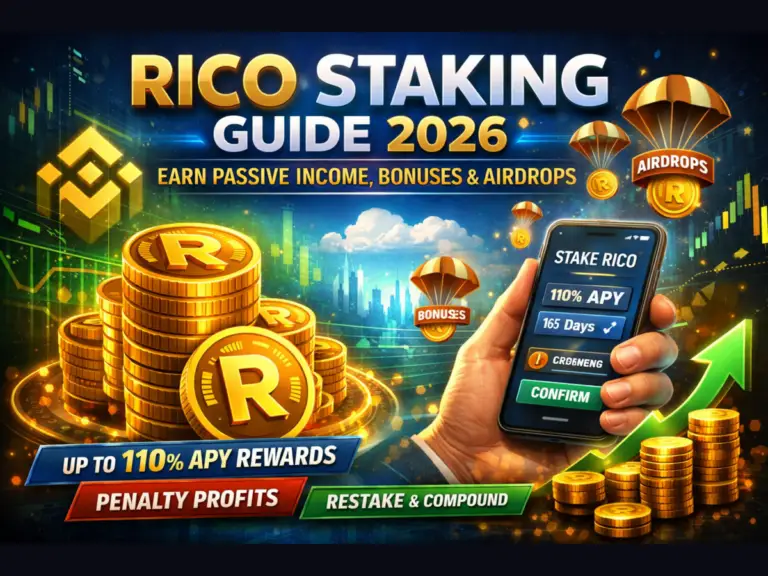
The staking system is one of the core retention layers of the ecosystem. Users stake RICO for fixed periods and earn rewards based on duration. The available lock periods listed in the docs are 30 days, 180 days, and 365 days. (rico-matrix.gitbook.io)
The published APY structure is:
30 days: 5% APY
180 days: 35% APY
365 days: 110% APY (rico-matrix.gitbook.io)
There are also size-based bonus incentives. Stakes of 15,000+ RICO may qualify for a +1% bonus, while 70,000+ RICO may qualify for a +5% bonus. The FAQ also shows a representative minimum staking threshold of 5 RICO. (rico-matrix.gitbook.io)
The reason longer staking matters is simple: the project wants to reward patience and discourage short-term exits. Longer locks are meant to reduce liquid market pressure, deepen commitment, and make the token feel less like a quick flip and more like a longer-duration ecosystem asset. (rico-matrix.gitbook.io)
Think of two brothers who receive the same bag of maize. One sells everything the same day for fast cash. The other stores his maize, waits for the right season, and plants part of it. The second brother usually has a better long-term outcome, but only because he had the patience to wait. Staking is designed around that same principle. (rico-matrix.gitbook.io)
What Happens If Someone Unstakes Early?
The early unstake rule is one of the clearest parts of the system. If a user exits before maturity, a 30% penalty applies. The docs say 15% is burned, 15% is redistributed to active stakers, and the user loses the maturity reward and bonus. (rico-matrix.gitbook.io)
This is clever because it turns impatience into value for the system. The person who leaves early loses, but their exit can strengthen the position of people who stayed committed. In other words, weak hands exiting can benefit strong hands that remain. (rico-matrix.gitbook.io)
A simple story makes it clearer. Imagine three women contribute money to a local savings group for one year. One woman pulls out too early. She pays a penalty. Part of that penalty is lost, and part is shared among the women who kept their promise till the end. That is very close to how the early unstake system works. (rico-matrix.gitbook.io)
Restaking, Compounding, and Airdrops
The staking design goes beyond a one-time reward. The restaking and compounding section explains that, instead of withdrawing everything at maturity, a user may restake their principal, earned rewards, bonus amounts, and redistributed rewards from penalty systems. That means a new cycle may begin from a larger base. (rico-matrix.gitbook.io)
This matters because compounding turns time into an advantage. A patient user is not just collecting one reward and stopping. They may be building a larger position over several cycles. The docs present this as one of the strongest long-term strategies inside the staking model. (rico-matrix.gitbook.io)
The project also includes an airdrop layer. A representative structure shown in the docs includes 2 RICO every 10 hours, with eligibility typically tied to holding at least a minimum balance of RICO or having an active stake. The stated purpose is to support retention, recurring engagement, and low-friction participation. (rico-matrix.gitbook.io)
Imagine a shopkeeper who gives loyal customers a small thank-you gift every time they keep coming back. The gift may be small, but it changes behavior. People feel noticed. They stay engaged. That is the role of airdrops in a token ecosystem. (rico-matrix.gitbook.io)
Learn-to-Earn: Turning Learning Into Participation
One of the most interesting parts of RICO Matrix is the learn-to-earn layer. The idea is that learning should not be treated only as passive consumption. Educational behavior becomes a form of participation that can be rewarded inside the ecosystem. (rico-matrix.gitbook.io)
The docs describe this as a type of knowledge finance. In this model, education is monetizable, participation is rewarded, and learning can become economically meaningful. The goal is to improve retention, deepen user involvement, strengthen ecosystem stickiness, and create more long-term platform value. (rico-matrix.gitbook.io)
Picture an elderly man named Pa Eze who joins a digital class to learn how to sell smoked fish online. In many systems, he pays, learns, and leaves. In the RICO Matrix idea, his learning journey can be part of the ecosystem’s economic life. He is not just a student; he becomes an active participant in a reward-driven knowledge economy. (rico-matrix.gitbook.io)
Community Rewards: Why the Crowd Matters
The ecosystem also includes a community reward layer. The published docs describe potential mechanisms such as royalty points, USDT reward distribution, participation-linked metrics, and activity-based benefits. (rico-matrix.gitbook.io)
That matters because the community is not treated only as an audience. It is treated as a participant layer inside the ecosystem. The platform is trying to shift users from being passive consumers to active contributors. When that works, it can improve retention, encourage engagement, reward long-term participation, and create better alignment between creators, readers, and the community itself. (rico-matrix.gitbook.io)
In a village, the success of a festival is not only about the drummer or the singer. The women who cook, the youths who decorate, the elders who organize, and the crowd who shows up all make the event successful. Community rewards are the platform’s way of recognizing that the crowd also creates value. (rico-matrix.gitbook.io)
Governance: Who Gets a Voice as the Platform Grows?
Governance is described as a long-term evolution layer. As the ecosystem matures, the docs indicate it may move toward broader governance systems covering things like reward parameters, incentive structures, ecosystem priorities, content promotion frameworks, and community-led growth initiatives. (rico-matrix.gitbook.io)
The logic is simple: as projects grow, users want a voice. They want input on how rewards work, how priorities are set, and how development moves forward. The governance vision also points toward participation-based signals such as staking alignment, community contribution, educational engagement, and on-chain activity, so influence is linked more to meaningful participation than to passive speculation alone. (rico-matrix.gitbook.io)
Think of a town union. In the early days, a founder may make most decisions. But as the town grows, people expect meetings, votes, and clear processes. Governance is that future town-hall stage of the ecosystem. (rico-matrix.gitbook.io)
Roadmap: How the Project Plans to Grow
The roadmap is laid out in multiple phases. Phase 1 focuses on foundation: launch the core ecosystem, launch the decentralized book library, onboard authors, enable publishing, activate initial RICO utility and burn flows, and establish the early product-market story around knowledge plus token utility. (rico-matrix.gitbook.io)
Phase 2 focuses on yield and education expansion: launch the staking system, activate passive reward mechanics, expand the education hub and skills layer, strengthen retention through staking and learning incentives, and broaden ecosystem awareness. (rico-matrix.gitbook.io)
Phase 3 focuses on growth infrastructure: launch analytics dashboards, pursue the RICO exchange listing, introduce growth boosters, improve participation tracking, and support broader creator, reader, and global adoption initiatives. (rico-matrix.gitbook.io)
That roadmap reads like the growth of a school. First, you build the classrooms. Next, you add a library and better teaching tools. Then, when the school becomes strong enough, you add bigger systems, better records, and wider visibility. The RICO Matrix roadmap follows that same “foundation first, expansion second, scale third” logic. (rico-matrix.gitbook.io)
Security and Trust: Why Transparency Matters
Trust is one of the most important parts of any on-chain project. RICO Matrix is built around smart contract logic on BNB Chain, and the project materials emphasize on-chain transparency, public contract references, verifiable transaction behavior, and lower dependence on off-chain promises. (rico-matrix.gitbook.io)
The trust model here is important. Websites can change. Marketing language can change. Explanations can be simplified. But deployed smart contracts remain the source of truth where applicable. That is why the project places emphasis on contract references, documentation, visible utility design, and clear risk disclosure. (rico-matrix.gitbook.io)
Think of the difference between a promise whispered in private and a record written in the village square for everyone to see. One depends on memory. The other depends on proof. That is the kind of trust model an on-chain ecosystem tries to build. (rico-matrix.gitbook.io)
What Makes RICO Matrix Different?
RICO Matrix is not positioned as a meme token, and it is not presented as a generic DeFi project. Its stated edge is the combination of a real product, real monetization flow, recurring burn activity, multiple utility layers, and a knowledge-driven ecosystem model. (rico-matrix.gitbook.io)
Compared with many Web2 platforms, it offers a different structure around creator monetization, wallet-linked ownership, community participation, and token-linked scarcity. Compared with generic Web3 tokens, it aims to stand out by offering recurring usage sinks, product-integrated token utility, activity-linked burns, and staking connected to a real ecosystem. (rico-matrix.gitbook.io)
The project’s core value flow can be summarized simply: users engage, authors monetize, revenue gets distributed, the community pool grows, token utility gets activated, and burns plus staking reinforce long-term alignment. That one sentence explains the full machine. (rico-matrix.gitbook.io)
The Simple Bottom Line
RICO Matrix is trying to build a decentralized knowledge economy where content, ownership, rewards, participation, and token utility all connect. It wants creators to publish directly, readers to own access in a wallet-linked way, communities to help curate and earn, and long-term supporters to benefit from staking, compounding, and reward layers. (rico-matrix.gitbook.io)
The real long-term question is not whether the idea sounds good on paper. The real question is whether enough people will use the platform consistently. If usage grows, token utility grows. If token utility grows, long-term participation becomes more attractive. If long-term participation grows, the ecosystem can become stronger. That is the central vision behind the project. (rico-matrix.gitbook.io)
For someone who wants the shortest possible explanation, here it is: RICO Matrix is a BNB Chain ecosystem that combines publishing, wallet-linked access, staking, token burns, learn-to-earn, and community rewards into one connected system designed to turn knowledge into economic activity. (rico-matrix.gitbook.io)
FAQ: RICO Matrix Explained
What is RICO Matrix?
RICO Matrix is a decentralized knowledge ecosystem built on BNB Smart Chain that combines publishing, wallet-linked access, staking, rewards, community participation, and token utility in one system. (rico-matrix.gitbook.io)
What is the RICO token used for?
RICO is used for publishing, purchase activity, decentralized curation, staking, reward eligibility, and broader ecosystem participation. (rico-matrix.gitbook.io)
What is the total supply of RICO?
The total supply is 100,000,000 RICO. (rico-matrix.gitbook.io)
What network is RICO on?
RICO runs on BNB Smart Chain (BEP-20). (rico-matrix.gitbook.io)
How does RICO staking work?
Users can stake RICO for fixed durations of 30 days, 180 days, or 365 days, with published APY tiers and bonus incentives for larger positions. (rico-matrix.gitbook.io)
What happens if a user unstakes early?
A 30% penalty applies, with 15% burned, 15% redistributed to active stakers, and no maturity reward or bonus paid to the early exiter. (rico-matrix.gitbook.io)
How are creators paid?
The representative revenue split shown in the docs is 50% to the author, 30% to the community pool, and 20% to ecosystem wallets. (rico-matrix.gitbook.io)
What makes RICO Matrix different from other crypto projects?
It combines decentralized publishing, wallet-linked access, staking, token burns, creator monetization, and community participation into one connected ecosystem. (rico-matrix.gitbook.io)